How Many Moose Are There in New Brunswick?

If you’ve ever driven through the forests of New Brunswick, you may have wondered just how many moose are living in the woods around you.
So, how many moose are there in New Brunswick?
The answer isn’t a single exact number.
New Brunswick’s moose population is estimated in the tens of thousands, with commonly cited estimates placing the provincial population somewhere around 20,000 to 30,000 animals. Older scientific population estimates have placed the number at approximately 32,000 moose.
The important thing to understand is that New Brunswick does not conduct a simple annual census of every moose in the province. Wildlife managers use surveys, harvest information, population indicators and Wildlife Management Zones to monitor the species.
That makes the question more complicated—but also more interesting.
And if you’re hoping to see a moose while exploring New Brunswick, there is plenty to learn about where they live, what they eat and when you’re most likely to encounter one.
Why Are There So Many Moose in New Brunswick?
New Brunswick provides excellent habitat for moose.
Much of the province is forested, providing food, cover and space for these large mammals.
Moose can use a variety of habitats, including:
- Forest
- Young forest
- Mixedwood areas
- Spruce and fir forests
- Wetlands
- Cedar swamps
- Lakes and ponds
- Freshwater areas
- Forest openings
Their habitat needs change throughout the year.
A moose may use one area for feeding and another for shelter, depending on weather, season, food availability and other conditions.
Where Are Moose Found in New Brunswick?
Moose can be found across much of New Brunswick.
They are particularly associated with forested and relatively remote areas where suitable food and cover are available.
Northern New Brunswick
Northern New Brunswick contains extensive forest and wilderness areas that provide excellent moose habitat.
The Restigouche and Madawaska regions are known for their large forest landscapes and remote terrain.
If you’re exploring northern New Brunswick, keep your eyes open when travelling through wooded areas, especially around forest openings and wet areas.
Central New Brunswick
Central New Brunswick also provides significant moose habitat.
The forests and backcountry around areas such as:
- Grand Lake
- Ripples
- Stanley
- Boiestown
- Doaktown
- Miramichi
provide extensive opportunities for wildlife encounters.
This is also the region where Mud to Moose Trail Adventures operates.
Our guided ATV and side-by-side adventures take guests into the New Brunswick backcountry, where moose and other wildlife may be encountered.
Southern New Brunswick
Moose are also found in southern New Brunswick.
The Fundy region is particularly interesting because Parks Canada monitors moose populations in Fundy National Park through aerial surveys.
Parks Canada reports that moose in Fundy are encountered more frequently in upland areas and less frequently near the coast.
How Many Moose Live Near Fredericton?
This is a question we hear from visitors interested in wildlife and ATV adventures.
There isn’t a reliable public figure for exactly how many moose live within a particular radius of Fredericton.
Moose don’t follow municipal boundaries.
They move through large forested areas depending on food, season, weather and other factors.
That’s why it is better to think of the Fredericton and central New Brunswick region as part of a much larger wildlife landscape rather than trying to assign a precise number of animals to the city.
If you’re travelling outside Fredericton into the surrounding countryside, keep watching the roadside and forest edges.
You never know what might appear.
Where Is the Best Place to See a Moose in New Brunswick?
There isn’t one guaranteed location.
Moose are wild animals, and their movements change constantly.
However, areas with:
- Extensive forests
- Wetlands
- Lakes and ponds
- Young forest
- Forest openings
- Remote backcountry
- Abundant vegetation
can provide suitable moose habitat.
Wildlife viewing is always a matter of opportunity rather than certainty.
That’s why a guided wildlife or wilderness adventure can be valuable.
A local guide understands the landscape and can help you recognize areas where wildlife may be present.
What Do Moose Eat?
Moose are herbivores.
Their diet consists primarily of vegetation.
Depending on the season and habitat, they may feed on:
- Leaves
- Twigs
- Aquatic plants
- Shrubs
- Young trees
- Woody vegetation
- Other available plants
Moose are particularly well adapted to feeding in forest and wetland environments.
They can also browse on vegetation that is difficult for many other large animals to reach.
A mature moose can consume a tremendous amount of vegetation each day.
When Is the Best Time to See Moose in New Brunswick?
There is no guaranteed time to see a moose, but some periods can be more promising for wildlife viewing.
Early Morning
Moose can be active during the early morning hours.
The cooler temperatures and lower human activity can make this an excellent time to watch for wildlife.
Evening
The hours around sunset can also be productive for wildlife watching.
This is one reason our Night Moose Safari is such a unique experience.
As daylight fades, you’re exploring the forest at a time when many people have already left the backcountry.
Fall
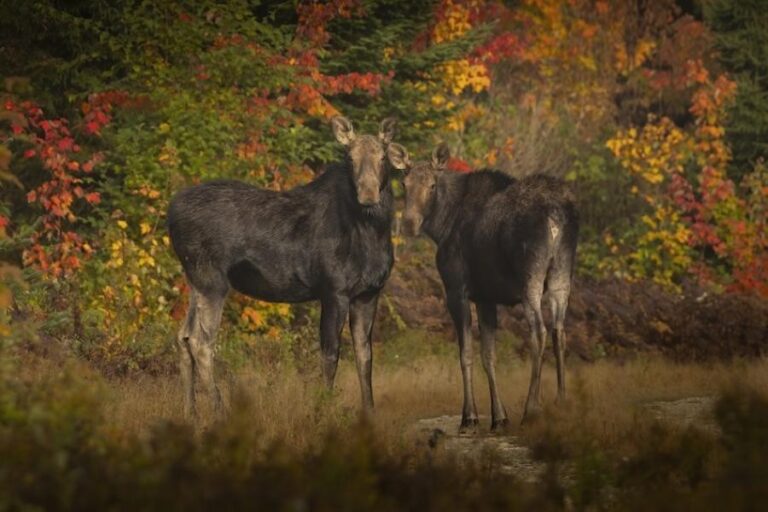
Fall is an especially interesting season for moose.
The breeding season, known as the rut, changes moose behavior.
Bull moose are focused on finding and competing for mates, while cows and bulls can become more active.
However, moose should always be observed from a safe distance.
What Is the Moose Rut?
The rut is the annual breeding period for moose.
During the rut, bull moose can become more active and may travel more extensively in search of cows.
You may also hear moose making unusual sounds.
The rut is one of the most fascinating times of year to observe moose behavior.
But it is important to remember that large wild animals can be unpredictable.
Never approach a moose simply because it appears calm.
How Big Is a New Brunswick Moose?

Moose are the largest members of the deer family.
A mature bull can be enormous.
Bulls are easily recognized by their large antlers, which grow during spring and summer.
After the breeding season, bulls shed their antlers.
New antlers begin growing again the following spring.
Cows do not have antlers.
A cow can give birth to one or two calves, generally in late spring.
How Long Do Moose Live?
Moose can live for many years in the wild.
Parks Canada notes that a moose can live up to approximately 20 years in the wild.
That means an adult moose you encounter could have spent many years moving through the same forests you are exploring.
Can Moose Swim?

Yes.
Moose are surprisingly capable swimmers.
Their large bodies and long legs allow them to move through lakes, ponds and rivers.
They can also feed on aquatic vegetation.
Seeing a moose swimming across a New Brunswick lake would be an unforgettable wildlife encounter.
Can Moose Dive Underwater?
Yes.
Moose can submerge their heads and even dive underwater to feed on aquatic vegetation.
Their long legs and large bodies make them surprisingly capable in water.
This is one of the reasons wetlands and lakes are important components of moose habitat.
Are Moose Dangerous?
Most moose want nothing to do with people.
However, they are extremely large and powerful wild animals.
A moose can weigh hundreds of kilograms and move surprisingly quickly.
You should never approach a moose.
Give it plenty of space.
This is especially important around:
- Cows with calves
- Bulls during the rut
- Moose that appear agitated
- Moose standing near roads
- Moose that have been surprised at close range
Watch from a safe distance and allow the animal to move away.
What Should You Do If You See a Moose?
If you encounter a moose while hiking, driving or riding an ATV:
Slow down.
Don’t rush toward the animal.
Give it space.
Never attempt to approach it for a photograph.
Stay quiet.
Avoid unnecessary noise or sudden movements.
Let the moose leave.
The best wildlife encounter is one where the animal can continue its natural behavior without being disturbed.
Watch for Moose While Driving in New Brunswick
Moose can cross roads and highways.
This creates an important safety issue for motorists.
New Brunswick identifies areas with elevated moose-vehicle collision risk, but wildlife can potentially cross roads anywhere in the province.
When driving through wooded areas:
- Slow down
- Watch the roadside
- Be especially careful around dawn and dusk
- Watch for more than one animal
- Be prepared to stop
If you see one moose, don’t assume another isn’t nearby.
Can You See Moose on an ATV Tour?
Yes, it is possible—but no responsible tour operator should guarantee a moose sighting.
That’s because moose are wild animals.
They aren’t waiting beside the trail for visitors.
Their movements are influenced by:
- Weather
- Food
- Season
- Time of day
- Human activity
- Breeding behavior
- Natural habitat conditions
At Mud to Moose Trail Adventures, we take guests into New Brunswick’s forest and backcountry where wildlife may be encountered.
The goal isn’t simply to find a moose.
It’s to experience the environment where moose live.
Experience a Night Moose Safari
One of the most exciting ways to explore the New Brunswick wilderness is after dark.
The Mud to Moose Night Moose Safari is a guided nighttime adventure designed around the possibility of seeing moose and other wildlife.
The forest changes dramatically after sunset.
Your headlights illuminate the trail.
The surrounding woods become darker and quieter.
Every sound becomes more noticeable.
And everyone starts watching the forest edges for movement.
A moose may appear.
Or you may see tracks, hear wildlife or simply experience the incredible atmosphere of the nighttime forest.
That’s what makes the adventure exciting.
Why Are Moose Important to New Brunswick?
Moose are an important part of New Brunswick’s natural environment.
They influence vegetation through browsing and are part of the province’s broader forest ecosystem.
They are also an important cultural, recreational and tourism resource.
For visitors, seeing a moose in the wild can become one of the defining memories of a trip to New Brunswick.
Moose Population Monitoring in New Brunswick
The province manages moose using Wildlife Management Zones and other wildlife-management tools.
New Brunswick currently has 27 Wildlife Management Zones, which are used by the provincial government to manage deer, moose, bear and other wildlife populations.
These zones account for differences in landscape, climate, geology, soils and other characteristics.
Wildlife management is important because population numbers can change between regions.
A single province-wide number doesn’t tell the whole story.
Are New Brunswick’s Moose Numbers Increasing or Decreasing?
This is a complicated question.
Moose populations can vary between regions.
Recent New Brunswick harvest information has indicated that populations were relatively stable in many areas, while declines were noted in some southern areas.
That is one reason wildlife managers use regional monitoring rather than relying on a single number for the entire province.
The exact population is also difficult to determine because counting every moose in a large, heavily forested province is not practical.
Why Moose Population Estimates Aren’t Exact
Imagine trying to count every moose in New Brunswick’s forests.
You can’t simply drive every road and count them.
Many moose are deep in the woods.
Others are moving.
Some are hidden by trees.
Some areas are difficult to access.
Instead, wildlife biologists use methods such as:
- Aerial surveys
- Population modelling
- Harvest data
- Wildlife observations
- Regional monitoring
- Habitat information
Fundy National Park, for example, uses aerial surveys to monitor its moose population.
Moose Are One of New Brunswick’s Most Fascinating Animals
New Brunswick is home to an incredible variety of wildlife.
But there is something special about seeing a moose.
Maybe it’s the size.
Yes it’s the enormous antlers of a bull.
Maybe it’s the surprise of seeing one standing quietly beside a trail.
Or perhaps it’s simply knowing that you’ve encountered a truly wild animal.
That’s why moose have become such an important part of the New Brunswick wilderness experience.
Explore Moose Country With Mud to Moose
At Mud to Moose Trail Adventures, we believe the best way to experience New Brunswick is to get beyond the pavement.
Our guided ATV and side-by-side adventures take guests into the forest and backcountry around Ripples, New Brunswick.
You may encounter:
- Moose
- Deer
- Birds
- Forest wildlife
- Mud
- Water
- Backcountry trails
- Beautiful New Brunswick scenery
But we don’t promise what nature cannot promise.
We can’t guarantee a moose.
What we can offer is an authentic wilderness adventure where you have the opportunity to experience the environment where moose live.
Ready to Search for Moose?
If you’re visiting New Brunswick and want to experience the province’s wilderness from an ATV or side-by-side, come ride with us.
Mud to Moose Trail Adventures
Ripples, New Brunswick
Guided ATV Tours | Side-by-Side Adventures | Night Moose Safari
Explore New Brunswick ATV Tours
Discover the Night Moose Safari
Explore Moose & Wildlife Tours
From Mud to Moose — experience the wild side of New Brunswick.
Frequently Asked Questions About Moose in New Brunswick
How many moose are there in New Brunswick?
There is no single current annual census of every moose in New Brunswick. Commonly cited estimates place the population in the 20,000–30,000 range, while an earlier scientific assessment estimated approximately 32,000 moose in 2014.
Where are most moose found in New Brunswick?
Moose occur throughout New Brunswick, particularly in forested and remote habitats that provide food and cover. Northern, central and southern parts of the province all contain suitable moose habitat.
Can I see a moose near Fredericton?
Moose can be encountered in the forests and rural areas surrounding Fredericton, but sightings are unpredictable and never guaranteed.
What is the best time to see a moose?
Early morning and evening can provide good wildlife-viewing opportunities. Fall is also an interesting period because of the moose breeding season.
Can I see a moose on an ATV tour?
Yes, it is possible. Mud to Moose tours travel through New Brunswick backcountry where moose and other wildlife may be encountered. However, sightings cannot be guaranteed.
Are moose dangerous?
Moose generally avoid people, but they are extremely large wild animals. Never approach one, especially a cow with calves or a bull during the rut.
What should I do if I encounter a moose?
Stay calm, keep your distance, avoid approaching it and allow the animal plenty of room to move away.
Why are moose important to New Brunswick?
Moose are an important part of the province’s forest ecosystem and are also significant to wildlife management, outdoor recreation and tourism.
Sources & Further Reading
For authoritative information about New Brunswick wildlife management, visit the Government of New Brunswick’s Fish & Wildlife resources and its Wildlife Management Zone information.
For information about moose in Fundy National Park, Parks Canada provides information about moose distribution, biology and population monitoring.
Always check current provincial regulations and wildlife guidance before entering the backcountry.